

四季折折
Couldn't load pickup availability
Shipping
Shipping
Shipping within Japan
Orders are shipped via Yamato Transport or Japan Post (Yu-Pack).
Shipping fees vary depending on the destination:
- Kanto, Kansai, Tohoku, Shinetsu, Hokuriku & Tokai: ¥880 per delivery address
- Chugoku & Shikoku: ¥1,100 per delivery address
- Hokkaido & Kyushu: ¥1,300 per delivery address
- Okinawa: ¥1,400 per delivery address
These rates apply to deliveries within Japan only.
International shipping is subject to separate rates and conditions.
FAQ
FAQ
お客様からよくある質問をまとめました。詳しくはこちら
A heartwarming, cute pattern
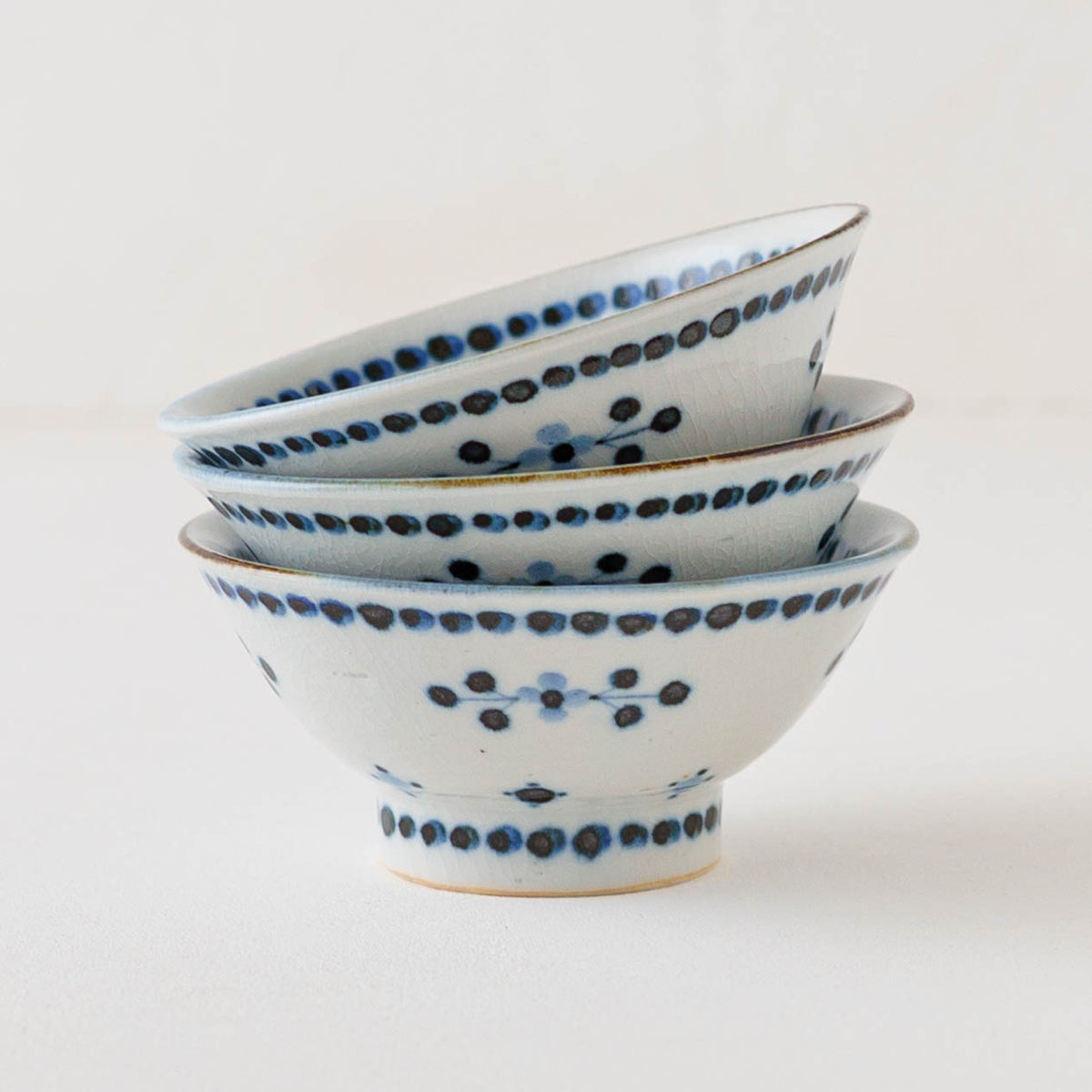
The "sometsuke" (blue and white) technique, a signature of Tobe ware, features lovely small flowers inspired by designs from the old Tobe ware of the Edo period. It is both stylish and charming, seamlessly blending the atmosphere of the good old days with a modern aesthetic.

A soft and gentle shade of blue for the small flowers. The delicate and adorable blue floral pattern beautifully accentuates your dishes. Furthermore, the fine "kannyu" (crackles) on the surface enhances its charm even more.

Kurawanka Bowl
This is a "kurawanka"-style rice bowl with a high, wide foot. "Kurawanka" is a Kansai dialect phrase meaning "Won't you eat?" The style originated in the Edo period when merchants selling food on boats along the Yodo River crafted bowls with a sturdy shape to prevent spills while on the water. You will find yourself soothed by this truly adorable form.

Enjoy the unique character of each piece
From the green hues that emerge from the glaze, the iron spots of various sizes that appear when the iron in the clay reacts during firing, the "kannyu" crackle patterns formed by the difference in shrinkage between the clay and glaze, to the subtle variations in pattern size, shape, and ink bleed characteristic of hand-painting—you can feel the warmth and flavor that only handmade craftsmanship can provide.

Because these pieces are finished by hand, there are individual differences. Each one has a unique character in terms of pattern placement, size, color irregularity, shading, pinholes, and iron spots. We ask for your understanding in advance that these are part of the charm of handmade items. We only ship products that have passed the quality standards of both the kiln and our shop. While you cannot choose exactly which piece you will receive, we hope you look forward to its arrival. If you have any concerns, please contact us before shipping and we will be happy to email you a photo of the specific item.
(September 2026: Prices have been updated)
◆◆View All Tousaigama Pieces◆◆
Product Details
| Origin | Japan |
| Material | Semi-porcelain |
| Size |
Diameter: Approx. 11.5-11.7 cm |
| Appliances |
Microwave: Safe |
|
Tousaigama Nagato Seitoujo |
|
Operated by the Nagato family Tetsuya, Junko, and Hiromu in Tobe-cho, Iyo-gun, Ehime Prefecture. |
| 1948 | Kenzan-gama Kiln founded |
| 2003 | Renamed from Kenzan-gama to Tousaigama |
| Tetsuya Nagato | 3rd generation of Tousaigama. His style focuses on celadon and white porcelain, pursuing forms that are both elegant and imbued with tension. |
| Junko Nagato | Proposes new forms of Tobe ware through painting techniques that utilize a variety of methods. |
| Hiromu Nagato | 4th generation of Tousaigama. While valuing traditional techniques, he engages in creative activities with a sense of freedom. |
| Tobe Ware |
|
Ceramics made in Tobe-cho, Iyo-gun, Ehime Prefecture and surrounding areas. Production began in the mid-Edo period, spanning about 240 years of history. In 1976, four types—white porcelain, blue-and-white, celadon, and tenmoku (iron glaze)—were designated as National Traditional Crafts, and in 2005, they were designated as an Intangible Cultural Property of Ehime Prefecture. There are nearly 100 kilns in and around Tobe-cho. Characteristics of Tobe ware include indigo patterns on white porcelain, a plump, thick, and unadorned shape, and the hardness of the material. Traditional patterns include the classic arabesque, as well as the shepherd's purse, tokusa (horsetail), and sun patterns. Today, new designs are being created while preserving these traditional techniques and motifs. |
| Usage Precautions from Tousaigama Nagato Seitoujo |
|
Because they use original clay and glaze, "kannyu" (crackle) patterns like motifs will appear. As you use the pieces, stains will appear, but they encourage you to view these as part of the piece's expression—"vessels to be nurtured." |
| Understanding Our Vessels |
| 〇 Because each piece is handmade, there are individual differences in color, shape, pattern, size, thickness, and weight. Even with the same glaze and clay, color irregularities and shading will occur. 〇 Since painting is done by hand, expressions may vary. 〇 Depending on the manufacturing process, small holes, small black spots, linear scratches, protrusions, pinholes, wobbling, or warping may be visible. 〇 Product images have been processed to be as close to the actual colors as possible, but colors and textures may look different depending on your computer or smartphone display. 〇 We deliver products that have passed not only the inspections of the manufacturer, kiln, or artist but also our own final inspection. 〇 Product photos are samples; the items you receive will not be identical in every detail. 〇 We do not accept returns or exchanges due to customer preference. Please understand this before purchasing. 〇 We hope you enjoy the "flavor" and "interest" unique to handmade items, which cannot be found in mass-produced industrial products! |