

四季折折
Couldn't load pickup availability
Shipping
Shipping
Shipping within Japan
Orders are shipped via Yamato Transport or Japan Post (Yu-Pack).
Shipping fees vary depending on the destination:
- Kanto, Kansai, Tohoku, Shinetsu, Hokuriku & Tokai: ¥880 per delivery address
- Chugoku & Shikoku: ¥1,100 per delivery address
- Hokkaido & Kyushu: ¥1,300 per delivery address
- Okinawa: ¥1,400 per delivery address
These rates apply to deliveries within Japan only.
International shipping is subject to separate rates and conditions.
FAQ
FAQ
お客様からよくある質問をまとめました。詳しくはこちら
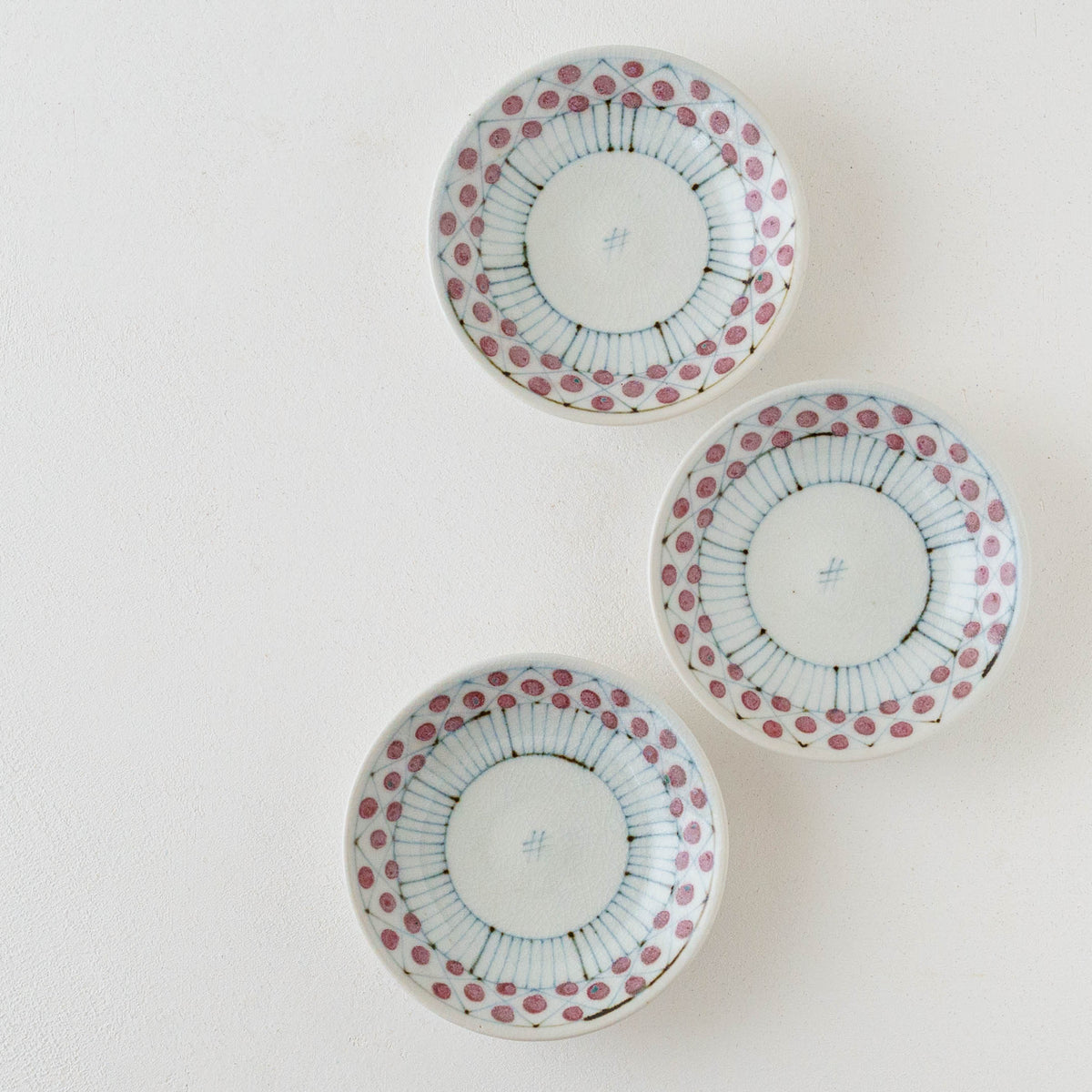
Heartwarming and Cute Patterns
The vessel is adorned with a lovely flowering fence pattern around its rim, inspired by the antique Tobe ware designs from the Edo period, executed in the classic Tobe ware "sometsuke" (blue and white) technique. The way the charms of a bygone era are seamlessly blended with a modern sensibility makes the pattern both stylish and adorable.

A Gentle Red That Soothes the Dining Table
The "Flowering Fence" pattern is a motif of a fence made from flowering trees. The soft, hazy red of the flowers is heartwarming. The green hues that emerge from the reactive glaze also lend a warmth unique to handmade ceramics. Additionally, the "kannyu" crackle pattern enhances the depth and character of the piece.

Perfect for sides or as a small serving plate
With a diameter of 11cm and a height of 3cm, this size is perfect not only for pickles, blanched vegetables, or dressed dishes, but also as a small serving plate for various side dishes. The foot is tall, wide, and sturdy, providing excellent stability for worry-free use.

Enjoy the unique character of each piece
From the green hues created by the reactive glaze and the iron spots of various sizes caused by the iron content in the clay during firing, to the "kannyu" crackle pattern resulting from the difference in contraction between the body and glaze, as well as the subtle variations in size, shape, and brushstroke bleeding unique to hand-painting each piece carries the warmth and character found only in hand-crafted work.

Because these items are hand-finished, each one is unique. The pattern design, size, color unevenness, variations, shading, pinholes, and black spots differ from piece to piece. We ask for your understanding in advance regarding these as characteristics of handmade pottery. We deliver items that have passed the quality standards and inspections of both the kiln and our shop. While you cannot choose which specific item you receive, we hope you look forward to its arrival. If you are concerned, please contact us before shipping, and we would be happy to email you separate photos of the actual item.
(September 2026: Prices have been adjusted)
◆◆List of Tousaigama pottery◆◆
Product Details
| Production Area | Japan |
| Material | Semi-porcelain |
| Size |
Diameter : approx. 11cm |
| Electronic Equipment |
Microwave : Safe |
|
Tousaigama Nagato Seitoujo |
|
Run by a family of three Tetsuya Nagato, Junko Nagato, and Hiromu Nagato in Tobe-cho, Iyo-gun, Ehime Prefecture. |
| 1948 | Kenzan Kiln founded |
| 2003 | Renamed from Kenzan Kiln to Tousaigama |
| Tetsuya Nagato | 3rd generation of Tousaigama. His style centers on celadon porcelain, pursuing forms that are both graceful and disciplined. |
| Junko Nagato | Proposes new forms of Tobe ware through painting techniques that utilize a variety of methods. |
| Hiromu Nagato | 4th generation of Tousaigama. While valuing traditional techniques, he engages in creative activities with a sense of freedom. |
| Tobe Ware |
|
Ceramic ware produced in Tobe-cho, Iyo-gun, Ehime Prefecture and surrounding areas. Production began in the mid-Edo period, with a history of about 240 years. In 1976, four types—white porcelain, blue-and-white (sometsuke), celadon, and tenmoku (iron glaze)—were designated as National Traditional Crafts, and in 2005, it was designated as an Intangible Cultural Property of Ehime Prefecture. There are nearly 100 kilns in and around Tobe-cho. Characteristics of Tobe ware include indigo patterns on white porcelain, a stout, thick, and unadorned form, and a hard material. The Arabesque pattern is the most iconic, while others like the Purslane, Tokusa (horsetail), and Sun patterns are also considered traditional. |
| Usage Precautions from Tousaigama Nagato Seitoujo |
|
〇Because original clay and glaze are used, pattern-like crackle (kannyu) will appear. With repeated use, stains may emerge; they propose a "vessel to grow," where these stains become part of its character. |
| Understanding "Vessels" |
| 〇Because each piece is handmade, there are individual differences in color, shape, pattern, size, thickness, and weight. Even with the same glaze and clay, color unevenness and shading will occur. 〇Since the painting is also done by hand, the expression may vary. 〇Depending on the manufacturing process, small holes, small black spots, line scratches, protrusions, pinholes, wobbling, or warping may be visible. 〇While product images are processed to be as close as possible to the actual colors, colors and textures may look different depending on your computer or smartphone display screen. 〇Our shop delivers items that have passed not only the inspections of the manufacturer, kiln, and artists, but also our own final inspection. 〇Product photos are taken from samples, so the actual item delivered will not be identical in every detail. 〇We do not accept returns or exchanges due to customer preference. Thank you for your understanding. 〇We hope you enjoy the "flavor" and "interest" unique to handmade goods that cannot be found in mass-produced factory products! |